
In the same way that my head does not clearly grasp the difference between practice and praxis (I’m being honest here) I also struggle with reflection and reflexivity. I’m not alone according to Kim Etherington (2004) who noted “When I first heard the word reflexivity, I thought it meant the same as reflection, as indeed did many of the people I conversed with. So it may be safe to assume that some of you, as readers, are also confused about that distinction (there are some who say there is no or little distinction and describe the meaning of one in terms of the other) and that addressing the differences and similarities might be a good place to start” p. 28.
I have always considered myself to be a reflective practitioner both in my teaching and project management practice, but reflexive??? Turning to my well-thumbed copy of Saunders et al. (2016) I note the glossary entries for some relevant terms:
“reflection Process of observing your own research practice and examining the way you do things.
reflexivity Self-examination, evaluation and interpretation of your attitudes and beliefs, reactions to data and findings, and interactions with those who take part in the research and acknowledgement of the way these affect both the processes and outcomes of the research.” p. 725
Etherington (2004) acknowledges that reflective practice is not solely the domain of clinical practitioners. Rolfe’s reflective model with the three simple steps of “what? so what? now what?” are well known beyond nurse education as an example. Schön distinguished between two forms of reflection, namely reflection-in-action and reflection-on-action with the former occurring at the time of the event and the latter following the event (Schön, 1983). In relation to management practices he considered the organisational setting to influence the manager’s ability to reflect-in-action and the practice of such reflection to add to his or her knowledge in the future. This is my background as a reflective practitioner but what has it to do with becoming a reflexive researcher, I ask myself?
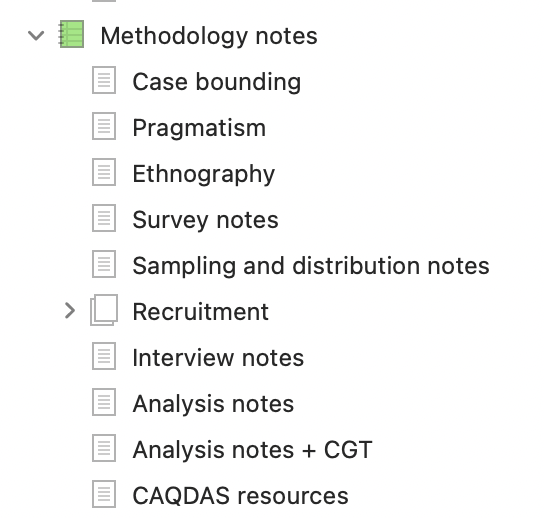
As I reflect on an aspect of my research (e.g. methodology in the screenshot) I make notes, electronically for the most part since my handwriting is appalling. Sometimes I record voice notes on my iPhone or send interesting items from my iPad to Trello. If at my desk I write my reflections directly in Scrivener, my writing tool of choice. I love being able to easily create documents, move them to different folders, essentially whatever makes sense at a certain point in my research journey.
Heading into what will hopefully be the final year of my PhD I find my research journal in Scrivener has over 52k words. This doesn’t include my reflections in NVivo where I write memos on data I have collected and literature I have reviewed. I try to synthesise relevant NVivo memos and make sense of them in my research journal in the hope that ultimately some will make their way into my thesis, also being drafted in Scrivener, comes as no surprise!
My practice is to review my recent journal entries on a weekly basis, move them to different documents or folders and develop elements for any chapter of my thesis.
On a monthly basis I write a separate reflection. Honestly, it sometimes feels I reflect more than I write but then remind myself that reflecting is an essential component of PhD research.
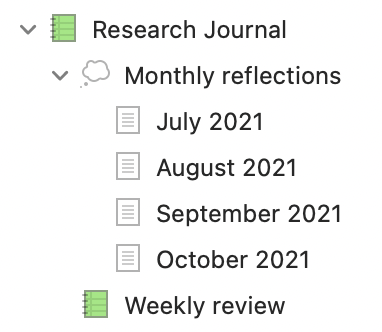
Back to my research journal, I was originally inspired by Anuja Cabraal‘s blog posts on the topic, particularly this one from 2013 and this more recent one from 2019. I set up my journal in Scrivener with similar headings and it evolved from there. As Anuja advises: “What do you put in a research journal? EVERYTHING!!“
Reflexive or reflective researcher terms both work for me, my research journal is the journey’s evidence.
Until next time, Sandra
Featured image courtesy of Bitmoji
References:
Etherington, K. (2004). Becoming a Reflexive Researcher – Using Our Selves in Research. Jessica Kingsley Publishers.
Rolfe, G., Freshwater, D. and Jasper, M. (2001). Critical reflection in nursing and the helping professions: a user’s guide. Basingstoke: Palgrave Macmillan.
Saunders, M., Lewis, P., & Thornhill, A. (2016). Research methods for business students (Seventh ed.). Pearson.
Schön, D. A. (1983). The Reflective Practitioner: how professionals think in action. Basic Books.
 Sandra Flynn
That is so inspiring Sandra. Being someone who prefers to hand write my reflections I have no idea how many words I have written but maybe my iPencil will be the future. I also have a lot of empathy with your exploration of reflection, reflective practice and reflexivity as I lost most of my first year down that rabbit hole.
It is so exciting that you are in your final year already! Speak soon, Clare
LikeLiked by 1 person
I keep buying pretty notebooks Clare, in the hope my handwriting becomes ones more legible but it’s wishful thinking on my part 🙄Interested to hear how you get on with the Pencil, imagine I’ll stick with old school technology aka a keyboard for the moment 😉S.
LikeLike