
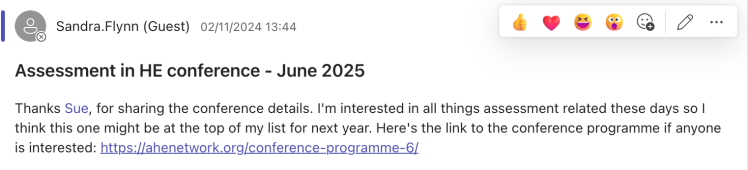
As an alumna of the Educational Research Department at Lancaster University I regularly attend the Saturday PhD Study Days, hosted by Dr Ann-Marie Houghton. With my PhD now in the rear view mirror, these days are dedicated to writing and research projects. Late in 2024 I was thinking about what conference I might attend in 2025 for personal and professional purposes and at one of these days, my Lancaster colleague Sue Beckingham, suggested the Assessment in Higher Education Conference held annually in Manchester, might be of interest:
The timing of the 2-day conference worked well for me, and even the airline schedule cooperated! I had done my prep work earlier and reviewed the details of the sessions that attracted me most. Invariably at conferences, the variety of sessions makes it challenging for participants to get to as many as we would like and so it was on Thursday morning, a trend that would continue outside of keynote and mini-keynote sessions:
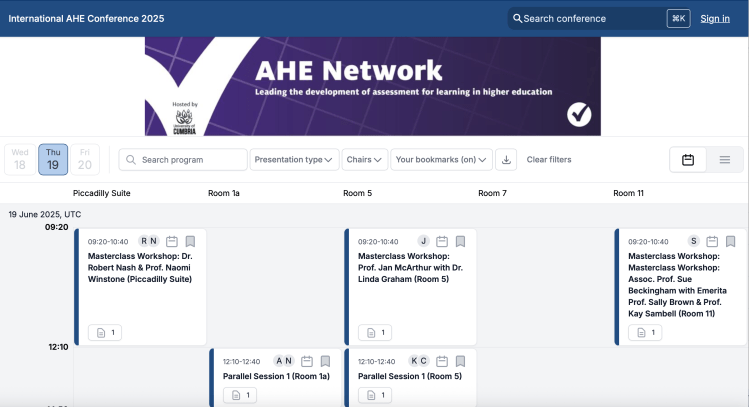
Sitting near the door of Room 11 meant that I could slip out of Assoc Prof Sue Beckingham’s Masterclass Workshop (I knew she wouldn’t mind) and check out the Piccadilly Suite Workshop. Both workshops were really informative and engaging and later I apologised to Prof Jan McArthur (who I know from her role as Head of the Educational Research Department at Lancaster University and whose session I did not make) with a glass of wine! It would take some wizardry to attend three workshops in the same session, so I did well at making two half ones!
The conference had a wide variety of themes that are worth noting here:
- Assessment for learning and the meaning and role of authentic assessment
- Leading change in assessment and feedback at programme and institutional level
- Addressing challenges of assessment in mass higher education
- Integrating digital tools and technologies for assessment
- Developing academic integrity and academic literacies through assessment
- Assessment: learning communities, social justice, diversity and well-being
- Developing evaluation and research methods for assessment practice and policy methods for assessment practice and policy
In my new-ish role as Teaching Fellow in Project Management at the University of Limerick’s Kemmy Business School, I am particularly interested in learning about ways to engage my students through assessment, both formative and summative. There was a lot to learn and take away from the conference and I find that if I procrastinate writing a reflection then it will unlikely be written at all. Hence, one week after the conference end, I find myself asking Microsoft Copilot to “Provide me with 2-3 questions on each of the seven themes that I can respond to that will allow me to create a well-rounded written reflection.” Having provided the questions, Copilot then asked me: “Would you like help organizing your responses into a structured reflection, or would you prefer to draft your answers first and then get feedback?” Since some themes were of more interest to me than others, I selected a number of questions to ponder that I will likely write reflections on ahead of the new academic year:
| Theme 1: Assessment for learning and the meaning and role of authentic assessment | – How did the conference redefine or reinforce your understanding of “authentic assessment”? – How might you apply or adapt these approaches in your own teaching or institutional context? |
| Theme 3: Addressing challenges of assessment in mass higher education | – What were the key challenges identified in scaling assessment practices for large student cohorts? – How did presenters propose maintaining quality and personalization in mass assessment contexts? |
| Theme 4: Integrating digital tools and technologies for assessment | – What concerns or opportunities around AI in assessment were raised? |
| Theme 5: Developing academic integrity and academic literacies through assessment | – Were there any innovative practices for preventing misconduct that you found compelling? |
| Theme 6: Assessment: learning communities, social justice, diversity and well-being | – What practices were shared for making assessment more inclusive and supportive of student well-being? |
As this post is nearing the 700-word limit (after which readers may switch off!) I plan to use the questions listed above to guide my thoughts in the weeks ahead, therefore the title of this post is suffixed with part 1, more to follow. The conference did not disappoint, thanks Sue for the recommendation, and I look forward to perhaps presenting next year along with renewing acquaintances, you know who you are, and making new ones.
Until next time, Sandra
Featured image courtesy of WordPress ‘Generate with AI’
Declaration: I used my University of Limerick Microsoft account to enter the following prompt into Copilot:
I am writing a 700-word reflection on my experience attending the AHE conference 2025 that had a variety of presentations, workshops and keynotes across seven themes as follows:
- Assessment for learning and the meaning and role of authentic assessment; Leading change in assessment and feedback at programme and institutional level; Addressing challenges of assessment in mass higher education; Integrating digital tools and technologies for assessment; Developing academic integrity and academic literacies through assessment; Assessment: learning communities, social justice, diversity and well-being; Developing evaluation and research methods for assessment practice and policy methods for assessment practice and policy
Provide me with 2-3 questions on each of the seven themes that I can respond to that will allow me to create a well-rounded written reflection.
 Sandra Flynn