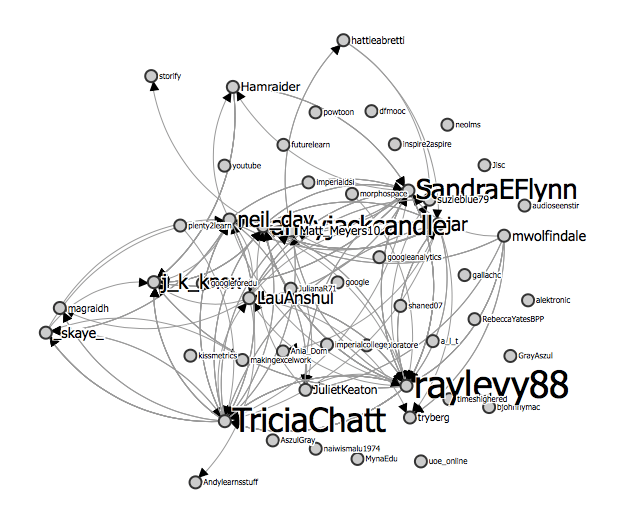
Last week was certainly an interesting week with the most intensive tweeting I’ve ever been involved in and this is reflected in the various numbers…
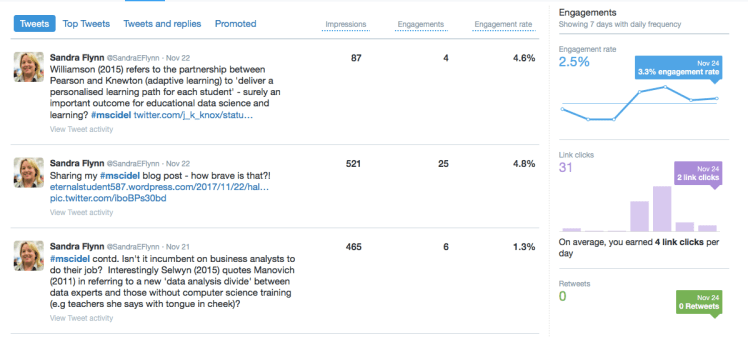
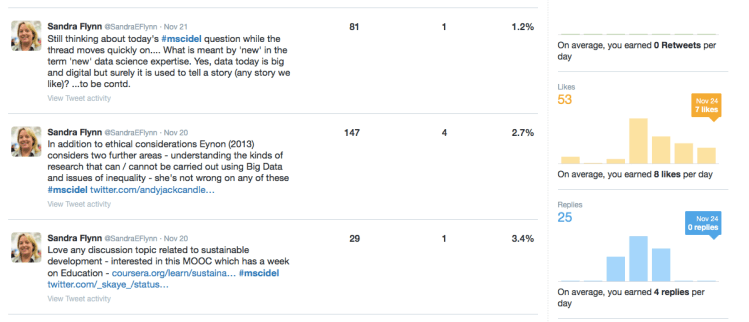 Impressions, engagements, likes, retweets – in a nutshell, tons (well, perhaps not tons exactly) of data to tell my Twitter story of the week. Is the story an objective one or one that supports a question I want to answer? As with the use of any research data it requires us to think carefully and critically about the questions we ask and how we ask and answer them (thanks Pete for the reminder!).
My personal story this week is that as a result of the Twitter activity is firstly, I feel more confident to use it going forward. No one’s out to ‘get me’ or criticise (critique is okay!) anything I might tweet. In the past I’ve really only used Twitter as a source of information but will now consider it as a potential two way communication medium with the right audience. I might even learn something new!
Secondly, I believe Twitter could be used as a study group forum, both asynchronous using an appropriate set of hashtags eg. #mscidel #studygroup and a synchronous session at a pre agreed scheduled time on a pre agreed topic, set of readings, group assignment, or anything that takes our fancy. I’ve also been advised by my ‘ever-present’ blog tutor that Twitter based journal clubs are fairly popular in medicine (see https://twitter.com/ioppnjc?lang=en-gb and operate like study groups). Watch this space!
Thirdly and finally, I believe that this week has developed our #mscidel community and while it’s true that the top tweeters and conversationalists looked to be those that are most active in the weekly discussion forums I have to admit that I feel ‘closer’ to more of my peers now than I did at the start of the week!
Now onto the final questions for the week, shorter than normal but hey, I was busy tweeting!
- How could you use this analysis for educational ends?
There was considerable discussion on the ethics and equality of data use from Twitter and other social network sources. I feel strongly that there is a responsibility on the part of any social researcher to be ethical in their sourcing and use of data. I found the discussion surrounding who should use data eg. training up teachers for this purpose to be quite interesting. I would stand firm that data analysis is a profession in itself and should be left to the professionals.
- How might this kind of data processing and visualisation relate to issues of ever-pervasive data collection, privacy, surveillance, and ethics?
This presentation a few years back by Valdis Krebs at TEDXRiga shouldn’t come as any surprise in today’s world, and it demonstrates how easy it is to ‘end up on the wrong side of the tracks’. Social network analysis provides the data interpretation framework that can deliver the outcome either ‘on the wrong side’ or ‘on the right side’ of the tracks, depending on what we’re looking for. While ethics is a key consideration, data privacy is an area where, in addition to legislation, ethics plays a large role.
This post isn’t intended to be comprehensive or exhaustive in any way. The week’s activity has provided me with more resources to consider for data analysis generally (not just for education purposes) and has enhanced my awareness of the issues to be aware of when engaging in analytics of any kind.
 Sandra Flynn