
As promised in Part 1 of this short series, this post considers the Community of Inquiry framework from Garrison, Anderson and Archer (1999), in my opinion another important model for online teaching and learning. However, in the two weeks since my last post I have been pondering on community. Interested, then please read on.
Brouwer et al. (2013) identified five overlapping domains for successful distance learning as follows:
“Technique, presence, motivation, anchoring and momentum” (p. 86)
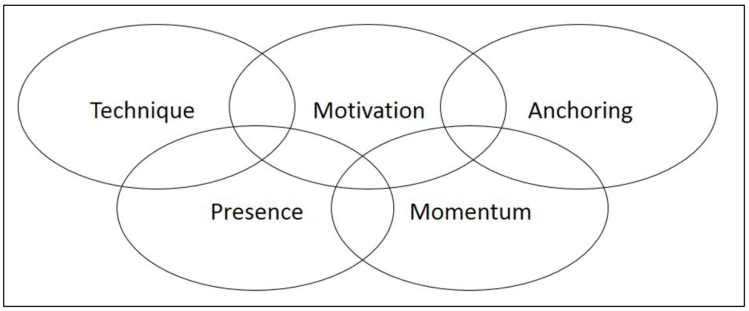
Of all these domains I consider the most important one to be presence, related to the Community of Inquiry (CoI) framework made popular by Garrison et al. (1999) that incorporates ‘cognitive, social and teaching presence’ with the goal of providing a positive educational experience to the learner.
So what is the Community of Inquiry?
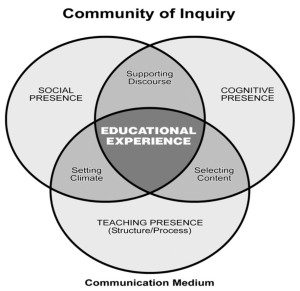
The importance of setting climate, resulting from the intersection of social presence and teaching presence cannot be underestimated and might be considered an output of good design (Garrison et al., 2010). So too, should supporting discourse, monitoring and regulating learning, be considered and the ability to design for this success is a requirement of a good online teacher. It is probably fair to suggest that while the CoI framework is intended to support and develop the critical inquiry techniques of the student, I would argue that responsibility for the educational experience, lies with the teacher.
In recent weeks there has be no shortage of opportunites to up-skill in any of the afore-mentioned domains. Examples I have been able to avail of include webinars (from my institutions where I teach and learn) on topics of interest regarding my practice of using Turnitin and Microsoft Teams, in addition to scheduled courses from the National Forum and DCU’s #OpenTeach offering for those of us who teach part-time (although I suspect from this week’s webinar a number of the 450 registered participants have full-time teaching roles but who now have to support their face-to-face classes in a very different way).
In the current COVID-19 climate there has been a surge to adapt face-to-face modules to an online format. This approach is entirely understandable given the circumstances, however, I would encourage module leaders, as soon as the opportunity arises, to take a step back and consider an appropriate balance between synchronous and asynchronous teaching and learning to get through this time of crisis. We can learn from each other and find the best way forward for all our modules and courses.
Communities of Practice Framework
Etienne Wenger (1999) posits that as a result of learning being treated as an isolated, individual learning experience, this leads to education being labelled as monotonous and often seen as a struggle by students. To counter this, Wenger argues that we should treat learning as a natural and social process that can be tackled in groups: communities of practice (CoPs). He warns that failure to recognise this social approach to learning can have a detrimental impact on education. Wenger sets out four necessary components of a successful CoP: community (‘learning as belonging’), identity (‘learning as becoming’), meaning (‘learning as experience’) and practice (‘learning as doing’). All of these components should be evident in any educational programme to support Wenger’s social theory of learning. If you’re not familiar with the concept of CoPs here’s a good place to start.
The challenge of remaining current is very real for most of us when it comes to being the best teachers we can be. It is not just about what we know, the content, but also about how best we can impart our knowledge, through the best suited communications media and our communities of practice, both formal and informal. This is an unprecented time for social learning and as Etienne Wenger, keynote speaker at today’s #AHEAD2020 webinar said, “it requires a different kind of leadership.”
Ultimately, it’s all about community.
Until next time,
Sandra
References:
Brouwer, N., Dekker, P. J., & van der Pol, J. (Eds.). (2013). e-Learning cookbook: TPACK in professional development in higher education. Amsterdam University Press.
Garrison, D. R., Anderson, T., & Archer, W. (2010). The First Decade of the Community of Inquiry Framework: A Retrospective. Internet and Higher Education, 13, (5-2), p.5-9.
Garrison, D. R., Anderson, T. & Archer, W. (1999). Critical Inquiry in a Text-Based Environment: Computer Conferencing in Higher Education. The Internet and Higher Education, 2(2), pp.87–105.
Wenger, E., & Wenger-Trayner, B. (2015). Introduction to communities of practice | Wenger-Trayner. Retrieved 27 March 2020, from https://wenger-trayner.com/introduction-to-communities-of-practice/
Wenger, E. (1999). Learning as social participation. Knowledge management review, 6(1).
Featured image courtesy of bitmoji
 Sandra Flynn