As 2021 draws to a close I reflect on two pieces of collaborative research work that had successful outcomes… both were published in academic journals, my first experience. Since my contribution involved over 100 hours in 2021 it’s worth reflecting on the process so that I’ll remember the experience for next time, and yes, there will be a next time, of that I’m certain.
It all started at the end of the spring semester 2020 when my colleague Fiona suggested working on a paper together over the summer months. “Great idea” I said, “what will we do?” So, we put our thinking caps on, our target of four months wasn’t a long time, as our MSc. research students will attest to. Around that time, there was a call for papers for a special issue of the ILTA journal, the Irish Journal of Technology Enhanced Learning, on the topic of eportfolios. Hmmm 🤔…
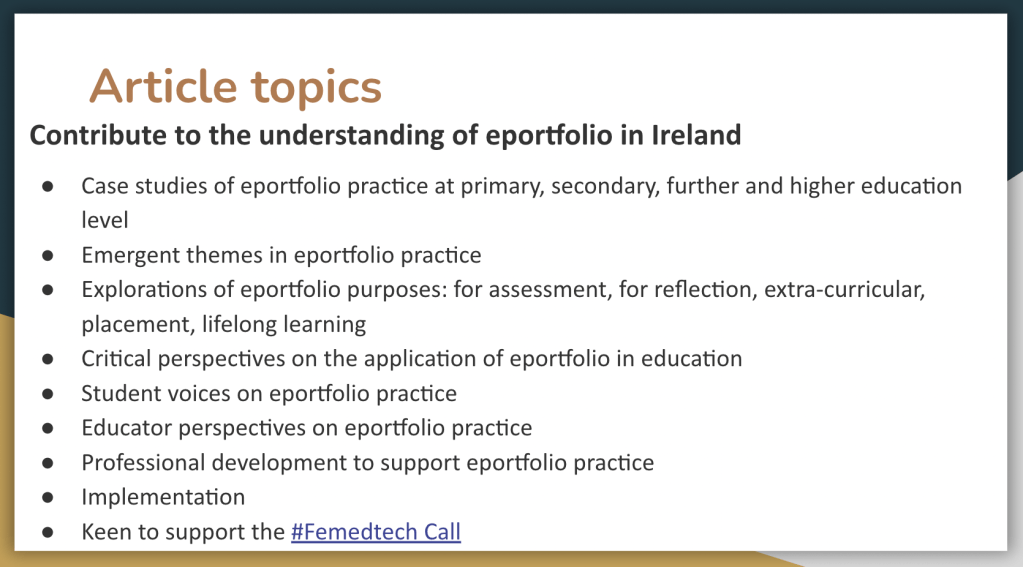
I had recently written an assignment paper for module three of my PhD programme and wondered if it could be developed to fit one of the themes, particularly “Explorations of eportfolio purposes: for assessment, for reflection, extra-curricular, placement, lifelong learning.” Lifelong learning. Hmmm 🤔…
I went along to the lunchtime webinar on 10 June to learn more and was delighted to hear about a planned writing workshop the following month. A 500-word abstract was required by the end of July and there was lots of support on hand from the editorial team at the workshop. In fact, over the entire period (more like twelve months rather than the antipated four 🙄) the special issue editors were hugely supportive and generous with their time. With the abstract submitted we awaited a decision and were thrilled to be invited to submit a full paper by 30 October, 2020. Life and work commitments meant that the writing process took longer than we had anticipated. We decided that synchronous writing sessions were the best hope of addressing the reviewers’ feedback and submitting our manuscript. This decision was a game changer and the collaboration began in earnest. Between June and August, 2021, we clocked up 30 collaborative hours that were both challenging and ultimately rewarding. The paper “Towards reflective project management: introducing the Portfolio-in-Practice” was published in December, 2021.
The second opportunity to collaborate came in February, 2021, from Susanne, a former MSc. research student with whom I have kept in touch over the years. The email title didn’t grab me: “Joint publication on online education in tourism?” Well, I didn’t know anything about tourism, but online education, now that was a different matter. The timeframe was tight for the special issue of the new journal, Project Leadership and Society, concerned with Digital Education and Learning in a Project Society. Specifically, Susanne was asking for my contribution along the following lines: “What we would need is further theory on lifelong digital learning behavior, MOOCs etc. Would you like to join us for such publication to help with this part?” Well, I was sold at lifelong, “count me in,” I replied.
This experience differed from the earlier one since I wasn’t familiar with the background to the project and the data already collected. I got up to speed, clarified my role and got to researching and reviewing the literature as assigned. This naturally led to contributing to the discussion section in a later revision of the manuscript. As lead and corresponding author, Susanne project managed our efforts, and we each worked asynchronously to the agreed deadlines. It was always a pleasure to meet up as a triad and chat about our progress to date and next steps. Managing three separate time zones was not always easy but we got there. The assignment of clear roles and responsibilities, along with agreeing deliverables and milestones (we are project managers after all), made the collaboration most successful. There were highs and lows of course, and times amongst the 75 hours I spent on my contribution that I wondered if we would achieve the desired outcome. I am happy to report that we did, and the paper “Digital Transformation in Tourism: Modes for Continuing Professional Development in a Virtual Community of Practice ” was accepted for publication in October, 2021.
So, what were the key learnings that I will take forward to future research collaborations?
- Agree clear roles and responsibilities for each researcher.
- Support each other if individual responsibilities become a challenge.
- Be realistic about timelines and engage with journal editors if the target timelines become an obstacle.
- Agree an approach that works for all, synchronous, asynchronous, shared manuscript drafts, comment tracking etc.
- Have a Plan B, just in case…
- Celebrate success 🥂
Until next time, Sandra
Featured image courtesy of Bitmoji
References:
Flynn, S., & Levie, F. (2021). Towards reflective project management: introducing the Portfolio-in-Practice. Irish Journal of Technology Enhanced Learning, 6(1), 118-130. https://doi.org/10.22554/ijtel.v6i1.94
Marx, S., Flynn, S., & Kylänen, M. (2021). Digital transformation in tourism: Modes for continuing professional development in a virtual community of practice. Project Leadership and Society, 2, 100034. https://doi.org/https://doi.org/10.1016/j.plas.2021.100034
 Sandra Flynn
One thought on “Collaboration – the name of the (research) game”