
My preparations to teach two modules on the MSc in Project Management programme in the spring semester this year involved considerable reflexivity on my previous semester’s module (MN6001 Project Management Science and Principles). I knew that Leganto had considerable potential for use in module assessment and I was also keen to support student engagement of responsible use of GenAI. Vevox’s survey feature was a positive experience that I was keen to use again as an in-class assessment but in a different format, potentially a guided reflection. I had learned that student engagement in group work appeared positive so this was something to leverage, individual work generally not so much (with some exceptions of course). I spoke with colleagues about our respective experiences and in parallel I was reading up on ‘all things assessment related’. So, when I came across the term relational pedagogy, that “puts relationships at the heart of teaching and emphasises that a meaningful connection needs to be established between teachers and students as well as between students and their peers” (Bovill et al., 2020, p. 12), I started thinking about what a meaningful connection might mean with and for my students in the forthcoming two spring modules.
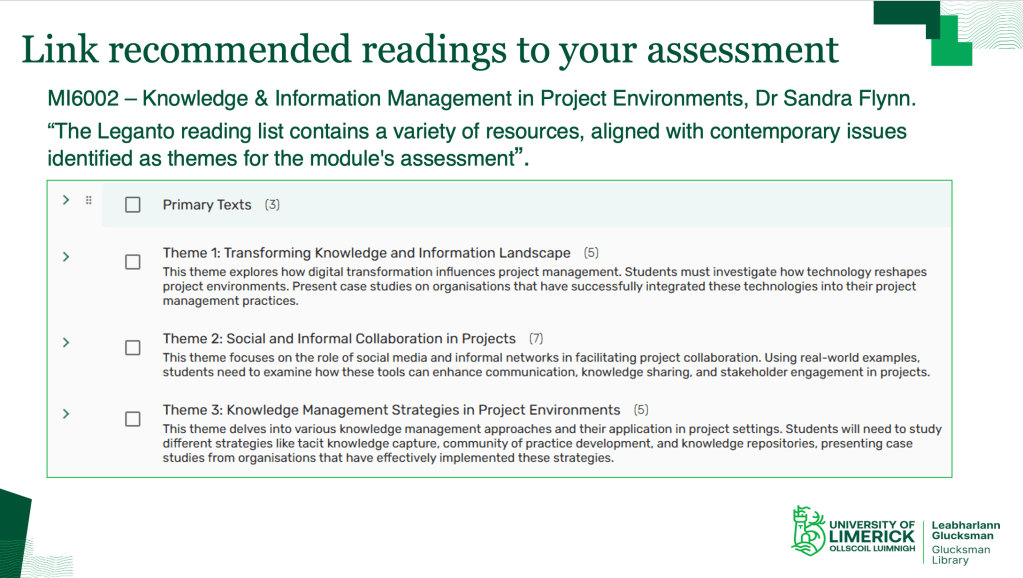
My assessment design for the first of the two 6-week modules (MI6002 Knowledge and Information Management in Project Environments) involved building on what I felt had worked well for the autumn module – group work, choice of assessment theme, curated Leganto reading list per theme (see slides below shared by Digital Learning Resources Librarian, Jesse Waters, at the January 2025 conference, Learning, Teaching and Assessment – Naming, Sharing and Transforming Practice).

Also, in-class group presentations along with a new in-class guided reflection, but with a tried and tested tool, Vevox (that I previously reflected on). I was keen to encourage formative peer feedback of group presentation work and since we had access to a new tool called peerScholar I felt it was worth a pilot. I studied as many resources as I could, designed a process and tested peerScholar with the VLE sandbox environment.
At the outset I knew the assessment design for module MI6002 would have some shortcomings, for example, all group work had to be finalised and submitted in Week 3, and presented in class between Weeks 3 and 6. From my own studies in recent years, I valued the opportunity for peer and teacher feedback on a draft that I could then improve for final submission. So, having read some literature on co-creation and co-design of assessment (see references list for examples), along with authentic (and authenticity in) assessment, I devised a process inviting students to optionally participate in the co-design of assessment for our next module, MN6072 Project Leadership and Governance. I had already submitted a successful application for ethics approval to Kemmy Business School’s Research Ethics Committee on the offchance that there might be a worthwhile paper arising from the initiative.
We hear more and more these days about the process of assessment by comparison with assessment as a product, that we are more familar with. My intention to engage interested and willing students to provide input to the assessment design, was to involve them in the process that would benefit both them and their peers in terms of the assessment product. I was delighted then, having explained my idea, that one third of the class of 46 students agreed to optionally participate in the co-design process.
So, what happened? Well, since this post is already at 600 words, the students’ feedback can wait for another post (or even a paper). For my part, in the sense that I did not know whether or not the process would achieve a successful outcome, there was a sense of relief when I read student feedback and reflections. Would I undertake such a process again? Absolutely, with enough willing co-designers putting their hands up!
Until next time, Sandra
Featured image courtesy of rui_libe from Pixabay
References:
Bovill, C. (2020). Co-creating learning and teaching: Towards relational pedagogy in higher education. Routledge.
Bovill, C. (2020). Co-creation in learning and teaching: the case for a whole-class approach in higher education. Higher Education, 79(6), 1023–1037. https://doi.org/10.1007/s10734-019-00453-w
Cook-Sather, A. (2020). Respecting voices: how the co-creation of teaching and learning can support academic staff, underrepresented students, and equitable practices. Higher Education, 79(5), 885–901. https://doi.org/10.1007/s10734-019-00445-w
Mercer-Mapstone, L., Dvorakova, S. L., Matthews, K. E., Abbot, S., Cheng, B., Felten, P., … Swaim, K. (2017). A Systematic Literature Review of Students as Partners in Higher Education. International Journal for Students as Partners, 1(1). https://doi.org/10.15173/ijsap.v1i1.3119
Smith, A., McConnell, L., Iyer, P., Allman-Farinelli, M., & Chen, J. (2025). Co-designing assessment tasks with students in tertiary education: a scoping review of the literature. Assessment and Evaluation in Higher Education, 50(2), 199–218. https://doi.org/10.1080/02602938.2024.2376648
 Sandra Flynn