
A couple of months ago I created a placeholder for a future post with this title. I drafted a few notes with the idea of expanding the traditional notion that for teachers “remaining current” meant keeping up to date with our knowledge area / domain (replace with your preferred term). I was particularly interested in understanding how industry practitioners who also teach part-time managed to remain current with new publications in their area apart from the occasional glance through the publications issued with their professional membership, in my case the Project Management Institute.
A few weeks ago I enrolled in another short course from the National Forum, this time on the topic of “Getting Started with Teaching and Learning“. I hadn’t planned to enrol since I was hardly a beginner online teacher but then I thought about the TPACK framework, decided that there would be something for me to learn and encouraged by my colleague, Fiona Levie, I duly signed up. As it happened, the timing couldn’t have been better since as a community under the guidance of Angélica Rísquez at CTL, UL this week, we are sharing knowledge and supporting each other at this difficult time.
So what is TPACK?
TPACK is a useful framework for the consideration of online teaching. Developed by Mishra & Koehler (2006) its goal was to introduce technology, building on the late twentieth century knowledge focus of content, and later, pedagogy (Shulman, 1986), into a new framework that remains popular in the second decade following its introduction. The TPACK framework (“TPACK.ORG”, n.d.) refers to the different types of knowledge required by teachers and the interactions between these types as depicted in the following image:
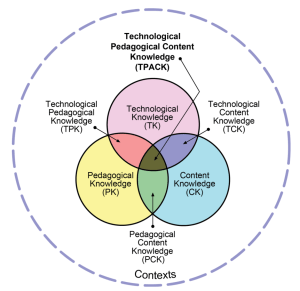
The idea of the framework is to understand the balance between components required for teachers using technology in their environments (classroom or online). It is helpful to see how the use of such a framework can contribute to a successful end product for example, development of a course or module, made available to students using a learning management system (LMS). Every end product (or output) however, must have a process from converting input(s) to output(s), for example, the knowledge of industry practitioners teaching part-time would reasonably be expected to be high on content, possibly medium to high on technology (learning technologist roles might provide support here) but low on pedagogy (owing to their part-time adjunct faculty position). In a conceptual analysis of the framework, Cox & Graham (2009) said of TPACK:
“It has inspired teachers, teacher educators, and educational technologists to re-evaluate their knowledge and use of technology in the classroom” (p. 60).
In the current COVID-19 climate the challenges of adapting a face-to-face module to entirely online are immense, but not insurmountable in the knowledge that solutions are intended to get us through this crisis, nothing more. Let’s do what we can to support each other across these three knowledge types. I have included some references below but appreciate there might not be much time available to read them right now.
Part 2 will focus on the Community of Inquiry framework from Garrison, Anderson and Archer (1999), in my opinion another important model for online teaching and learning.
Until next time,
Sandra
References:
Brouwer, N., Dekker, P. J., & van der Pol, J. (Eds.). (2013). e-Learning cookbook: TPACK in professional development in higher education. Amsterdam University Press.
Cox, S., & Graham, C. (2009). Diagramming TPACK in Practice: Using an Elaborated Model of the TPACK Framework to Analyze and Depict Teacher Knowledge. Techtrends, 53(5), 60-69.
Garrison, D. R., Anderson, T. & Archer, W. (1999). Critical Inquiry in a Text-Based Environment: Computer Conferencing in Higher Education. The Internet and Higher Education, 2(2), pp.87–105.
Mishra, P. & Koehler, M.J. (2006). Technological Pedagogical Content Knowledge: A Framework for Teacher Knowledge. Teachers College Record, 108(6), 1017-1054.
Shulman, Lee S. (1986). Those Who Understand: Knowledge Growth in Teaching. Educational Researcher, 15(2), 4-14.
Swallow, M. J. C., & Olofson, M. W. (2017). Contextual Understandings in the TPACK Framework. Journal of Research on Technology in Education, 49(3-4), p.228-244.
Featured image courtesy of bitmoji
 Sandra Flynn
Another great and timely article Sandra.
Wondering if there’s any cheap way of doing the Teaching and Learning PgDip cheaply/for free, flexible/part-time and online?
LikeLike
Thanks Pat,
There are a quite a few really good short courses and MOOCs out there that I’ve enjoyed if it’s the learnings you’re after. PG certs and dips cost of course but I’m sure I’ve seen a handy list of Irish offerings somewhere. I’ll dig it out and send it your way.
S.
LikeLiked by 1 person
Cheers Sandra.
LikeLike