
Readers will be forgiven for thinking that this post purports to be a meaningful reflection on perhaps social responsibility, ethical practice, or indeed any of the sustainable development goals, since teaching and research in this area is a passion of mine. No, this post is about a different set of 3 Ps that have been somewhat of a rollercoaster of highs and lows in my current research project over the past number of weeks. The 3 Ps in question are Purposive (sampling), Panic and Patience.
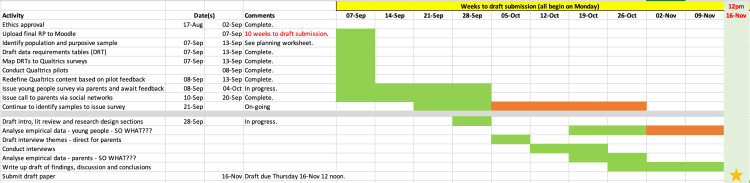
In time to come no doubt I will forget what a rollercoaster this period has been, and so it seems opportune to capture the highs and lows in the form of a timeline as a reminder to myself that process of conducting research is a journey and not always a straighforward one.
Earlier this year public health guidance around the Covid-19 pandemic in Ireland advised older people in Ireland not to leave their homes. They could not visit family or friends, have visitors to their home or go outside it for any reason. Based on Eurostat data (“Database – Eurostat – Digital Economy and Society”, n.d.) it may well be that the traditional telephone was the only communications medium for many, especially those living alone. For those isolated and wishing to keep in touch with family and friends through a richer medium than the telephone, the availability of digital communications (also known as information and communications technology, abbreviated as ICTs) for example video calls, individual and group messaging (one-to-one and one-to-few/many) might seem an obvious solution. However, for anyone without access to, or unfamiliar with navigating, the internet, and without personal assistance to help set the ICTs up in a physical environment, the challenges were considerable.
It seemed to me that this was a once-off opportunity to capture data from young people about their family experiences during this time. My research idea was to explore the intergenerational exchange brought about by young people supporting their senior cohort family members with digital communications throughout the several weeks of lockdown during the Covid-19 pandemic in Ireland.
Over the summer I read widely and worked on drafts of a research proposal. Those I spoke to about the idea were supportive that this was an important piece of research to pursue and for those who were parents of young people and family members of older adults engaged in this intergenerational experience it seemed that empirical data would be easy enough to gather. Well, it didn’t turn out quite like that. Four colleagues agreed to share my survey with their younger generation family members (children doesn’t seem to be an appropriate term in this context). In addition, since I would not be collecting data from the older family members who were supported by the young people at this time, these four individuals agreed to interview directly with me to share their thoughts on the learning experience that occured across the generations in their family.
Once ethical approval was granted for my study I started working on my purposive sample using mostly teaching and learning networks either through direct approach or through my social media channels. You know who you are and I thank you for your support. And so I waited patiently, and panicked, waited patiently for longer and panicked a little more. Here is what the timeline looked like (with amber weeks added to address the rising panic):
Then a breakthrough came when I was granted approval to distribute the survey to the student population at UL on Monday 5 October – phew, what a result, this was the gamechanger I needed. Email sent, I sat back and watched the numbers to the WordPress post containing the details rising. WordPress even sent me a notification to tell me about the spike (that was a first!):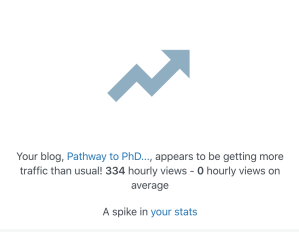
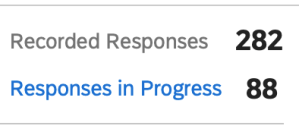
I gingerly took sneaky looks at Qualtrics to see if the clicks suggested in the WordPress stats converted to survey responses in Qualtrics. At the time of writing, less than 5 days after the email was distributed, this is how the response rate looks:
It’s been a fascinating week reviewing the incoming data guided by the first three of Braun and Clarke’s 6 phases of thematic analysis (thank you Orna Farrell for pointing me in their direction a while back):
- Familiarising yourself with your data
- Generating initial codes
- Searching for themes
I won’t spill the beans on any of the initial themes at this point, only to mention that one of the 3 Ps mentioned in this post figures considerably 😉
The survey remains open until the end of October, 2020, and may be accessed through this link in case you might like to forward to any 18-25 year olds that you know with older family members living in Ireland. Even if they did not provide such support, this is useful demographic data to capture.
Until next time, Sandra
References:
Braun, V., & Clarke, V. (2006). Using thematic analysis in psychology. Qualitative Research in Psychology, 3(2), 77-101.
Database – Eurostat – Digital Economy and Society. Retrieved 5 August 2020, from https://ec.europa.eu/eurostat/web/digital-economy-and-society/data/database
Featured image courtesy of Pixabay

