
I refrain from using the term literature review in the title of this post since I’m a long way from that point in my research project. I have, however, been reading a lot in the months since I shared my rationale in this post for wanting to use Nvivo for my literature review. I have been reading a lot in that time, highlighting sections of PDF copies, making notes in my reading log spreadsheet and so on. The one thing I have not done, is what I said I would do and that is to use Nvivo for highlighting and annotating, getting ready for coding when the time comes.
This week one of my peers asked a simple question: “For those just getting acquainted with NVivo, how’s it going?” Hmmm. I responded with: “My concern is that I might end up with viral coding when what we want is vista coding so for me an offline (outside Nvivo) setup is working for now (EndNote and trusty spreadsheet).” The next comment made me step back and reflect:  “Viral?” “Vista?” “Qu’est-ce que c-est?
I am terrified of viral coding and not at all sure that I have a vista of my project literature at this point. It’s early right, so not a problem? Hmmm. Jackson and Bazeley (2019) use a metaphor of the Grand Canyon to explain the vista structure whereby there are many vistas of the canyon from different viewing platforms and angles (p. 108). Vista coding of the literature and indeed any part of the project analysis is the goal, to look at the data from these platforms and angles, then code. Right now I feel my vista is from a helicopter high above the canyon and I still have to land at the various viewing points. A viral approach to coding on the other hand is a bit like a virus and we all know how quickly viruses can spread. Such a structure is therefore unhealthy and to be avoided in our projects. I learned about viral coding at one of our Nvivo workshops last semester (thank you Steve) and clearly have taken it to heart. Still, avoiding coding of any of the literature I have read thus far is not the answer.
Further expert advice suggests that while I do wish to be careful it is possible to fix a viral structure (Jackson & Bazeley, p. 122). I would prefer not to arrive at that point however, so advice from the experts is welcome:
“Thinking about what you’re reviewing, why, and how – and developing systematic structures for capturing those thoughts – is always the best starting point.” (Silver, 2020)
“Stop, think, write, rather than piling in to coding. Key foci being the questions of why am I reading this? what’s the relevance to my project? what are its qualities/shortcomings?” (Wright, 2021)
Back to my research project in Nvivo and it looks just as I had left it in December. I have read, highlighted and annotated sections of two books and created a structure of top level nodes.
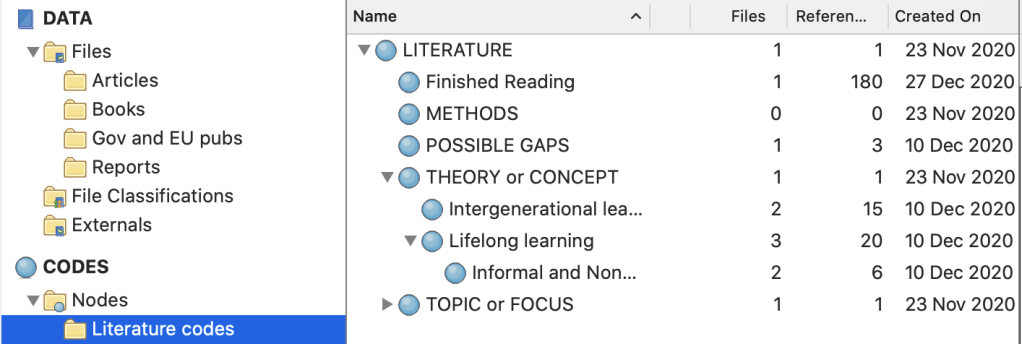
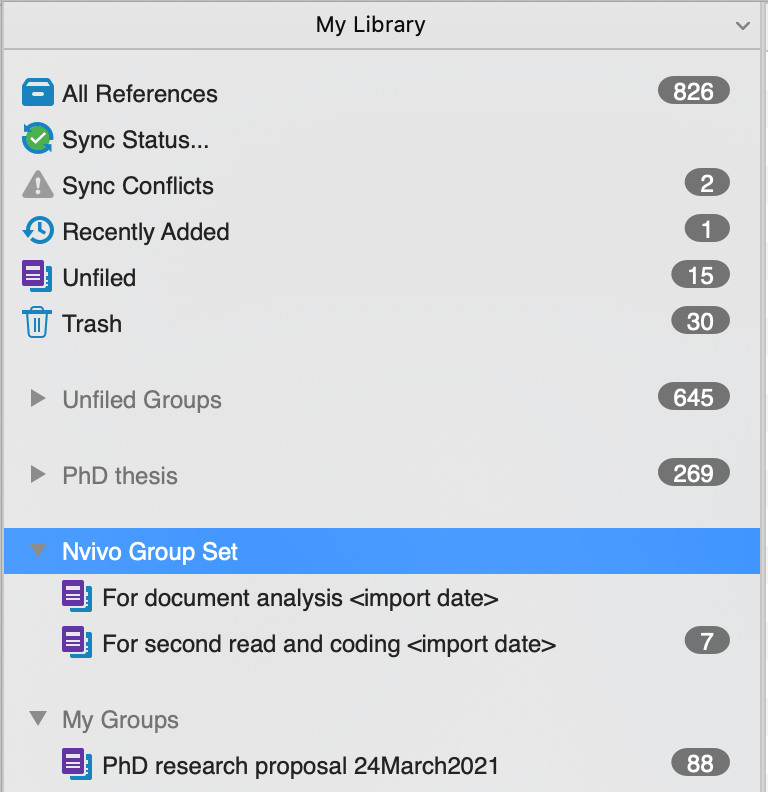
Taking the advice offered on board I plan to delete the articles I had already imported from EndNote and repeat the exercise selectively. Reading offline and taking initial notes makes sense to see if the article is something that will have value to my project. I have attached my highlighted PDF to the record in EndNote so that when imported across to Nvivo the highlighting will remain in place. In EndNote I have created an Nvivo Group Set and here is where I plan to create dated folders for every import into Nvivo. Another peer and I were wondering about this a while back since we didn’t want to end up with duplicate files in Nvivo so this approach should work.
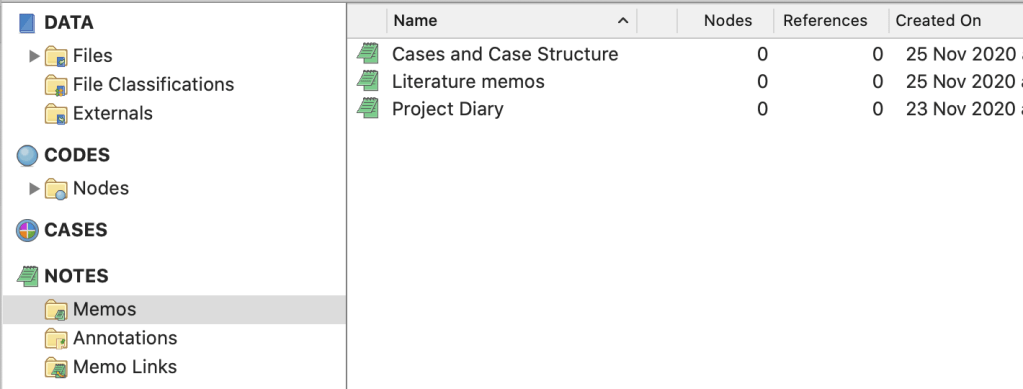
While I did try to keep my Project Diary in Nvivo using the memos feature, it works better for me in Scrivener where my Research Journal currently has a word count of 22,344 words (if only they were thesis words!). Keeping Literature memos in Nvivo makes sense though and I’ve made a start on that (not showing it in the screenshot though since these are my personal notes and reflections on selected literature this week).
This is part of the series of “organising the chaos” posts on tools I have used with reasonable success in the structured part of my PhD programme and hope to continue their use for my PhD research project.
Until next time, Sandra
Featured image courtesy of Bitmoji
References:
Jackson, K., & Bazeley, P. (2019). Qualitative data analysis with NVivo (Third ed.). London: Sage.
Silver, C. (2020). The crux of literature reviewing: structuring critical appraisals and using CAQDAS-packages. Retrieved from https://www.qdaservices.co.uk/post/the-crux-of-literature-reviewing-using-caqdas-packages
Wright, S. [@stevewright1976]. (2021, April 9). “Stop, think, write rather than piling in to coding. Key foci being the questions of why am I reading this? what’s the relevance to my project? what are its qualities/shortcomings?” Retrieved from Twitter.com
 Sandra Flynn
Thanks for sharing your process Sandra. I’m using Zotero and NVivo, and I think I’m going to try your EndNote folder structure in my Zotero. I’ve also given up on Word – I only use it once I’ve got a complete chapter draft to send to my supervisor, but I do all my drafting in Google Docs and my blog. That way, I can move across devices easily – everything is in the cloud and easily accessible from anywhere.
LikeLiked by 1 person
Thanks Gabi. I find it useful to capture my learnings as I go if only for my own reference!
Last week I was importing PDFs of gov policy docs directly into Nvivo in batches. I noted that Nvivo recognised the filenames of those already imported and only imported the new ones. That was handy. I’m not sure if Nvivo works the same for EndNote on this, hence the group set folders with the import data appended. I’ll check that out and see what happens. We certainly don’t want duplicate literature files in Nvivo!
LikeLiked by 2 people