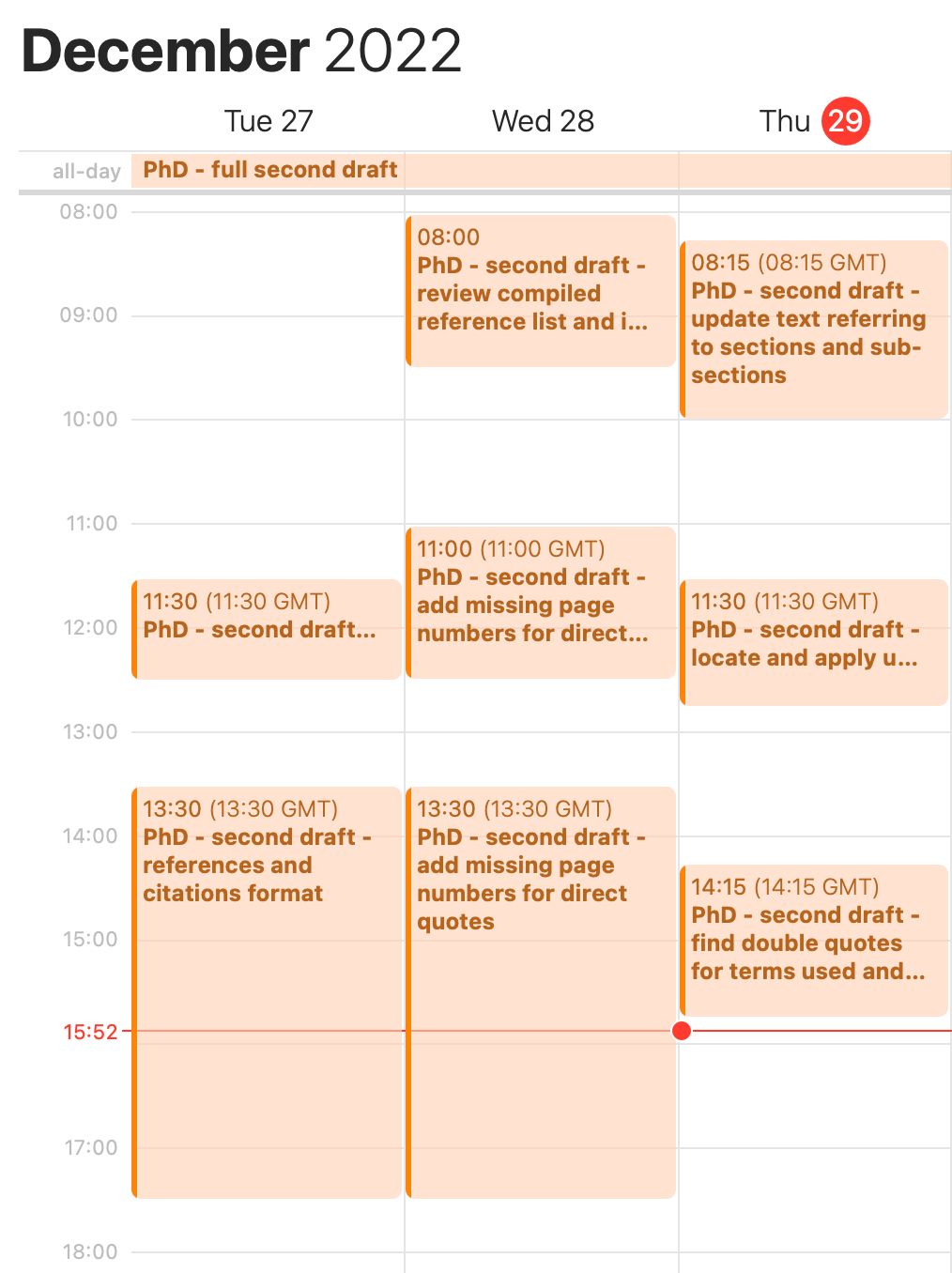
I’m not sure I would describe these as ‘little things’ given the amount of time I have spent on them in this Twixmas week (16 hours recorded so probably a bit longer if I include thinking/wondering time!). However, addressing issues in my PhD manuscript so that my supervisor doesn’t have to comment on them again is time well spent in my opinion, along with a few issues not yet commented on for which decisions now need to be made and actions taken. This is my Twixmas 2022 list in no particular order…
EndNote and references for organisations and corporate authors. For a while now I have been wondering how to fix the many references I have from government departments and international organisations that I referred to in my policy review findings. This week I had to tackle the problem and the solution was an easy one but not at all intuitive. So what happened? Well, a sample reference ‘before’ looked like this in the reference list: Organization, W. H. (2020). Decade of Healthy Ageing 2021-2030. Retrieved 30 September 2020 from [webpage]. A reader might hazard a guess at who the organisation is but shouldn’t have to. The in-text looked like this: (Organization, 2020) – no fun for the reader. Once the ‘fix’ is applied the same reference looks like this: World Health Organization. (2020). Decade of Healthy Ageing 2021-2030. Retrieved 30 September 2020 from [webpage]. So, what was the fix I hear you EndNote users asking? Answer, add a comma at the end of the author field so World Health Organization now reads World Health Organization, …Yep, that little comma makes all the difference.
Sections and sub-sections. I thought I was giving the reader a little variety in how I referred to sections within chapters, but having looked at PhD theses from one or two alumni I agreed with my supervisor that consistency might be best. So, each chapter has a few sections and a number of sections have sub-sections, so sections and sub-sections are all now in order and hopefully clear for the reader to follow.
Single quotes and double quotes. Following APA 7th style, the manuscript was building up nicely, with direct quotes correctly using double quotes for the most part. The trouble was that I was using a mixture of double and single quotes for terms I wanted to stand out for the reader. For consistency I decided to use single quotes so as not to confuse the reader who might be expecting a page cited owing to the use of double quotes. The approach is consistent and it looks clear but whether I should use single quotes at all remains to be decided.
Focused or focussed. Somewhere in my subconscious I must be an American writer, or perhaps I have read too many American-authored/published books over the years. I have always used focused and not focussed. The latter always looks wrong to me and I want to correct it. For consistency I will stick with UK English and resist the temptation to correct. Now I wonder which spelling is correct in Irish English??? A rhetorical question for another day.
Missing page numbers for direct quotes. I guess I’m not a proofreader since I had missed a number of these and incorrectly wrote others. A slip of the finger hitting the lower case 2 key rather than the upper case @. Ah well, nothing for it but to correct or add the missing numbers my supervisor noted and trawl through 50k words just in case there were others.
Straight quotes and curly quotes aka smart quotes. I admit that I never gave this a second thought since I use the same key on my keyboard all the time. In my defence, the 13inch screen on my MacBook Air probably is not the best for spotting whether a quote looks straight or curly. Nonetheless, I set about looking for a solution that would fix any occurrences for the entire manuscript. For Scrivener users (on a Mac anyway) here’s the magic path: Edit > Substitutions > Smart Quotes. Magnifying my document to 150% indicates that they are all smart and curly!
Formatting images from Scrivener that are wayyyy too big in Word. This is a reminder to myself for when I next need to compile my manuscript from Scrivener to Word. Just cut/paste the image in Word and the sizing will be corrected -it works!
Well, that’s a wrap from Pathway to PhD for 2022. Thanks for reading and may I wish you the best of everything for the year ahead. As for me, it’s back to the ‘not so little things’ of tightening up my argument, ask and answer the so what questions, and the rest…
Until next time, Sandra
 Sandra Flynn
Hi Sandra, I’m impressed that you’re at the stage of standardising (standardizing?!) your straight/ curly brackets… It sounds very much like end-stage proof-reading to me. Watching this space, as you are my inspiration for finishing mine!
LikeLike
Thanks Gabi, (although with a feedback response table that runs to 31 pages and took over 100 hours) I am keen to get closer to the finish line…
LikeLike