
As I sit down to reflect on the journey for the research paper co-authored with my fellow PhD alumnus from Lancaster University, Dave Gatrell, I realise that much of my planned reflection has already been reflected on (a bit of a mouthful but here’s the link to save me repeating myself). This reflection therefore focuses on the period from collecting the research data from participant student assessment co-designers and their cohort peers to the present, with our next scheduled activity (no pun intended) being our forthcoming presentation at the Assessment in Higher Education (AHE2026) conference in June.
Coming from an industry background of project management and process improvement I like to reflect on my teaching practice and identify ways to improve the experiences of my students, whether on-campus or online. Having collected the qualitative data from my participants I wondered if there might be something a little different to my planned thematic analysis approach that would lend itself to the study. In April 2025, our small ‘Tuesday gang’ of PhD colleagues (all graduated by this time) was still meeting to catch up and chat about any research work we were pursuing. I asked Dave if he would look at my survey data to see if Activity Theory might be suitable and if so, would he like to collaborate? And so, our research project commenced in earnest.
In the months that followed, I worked on the literature review section while learning as much as I could about Activity Theory. Dave pointed me towards suitable papers to help me along, and I hope I wasn’t too much of a burden with all my questions. Once I saw the framework take shape for our study I understood it better.
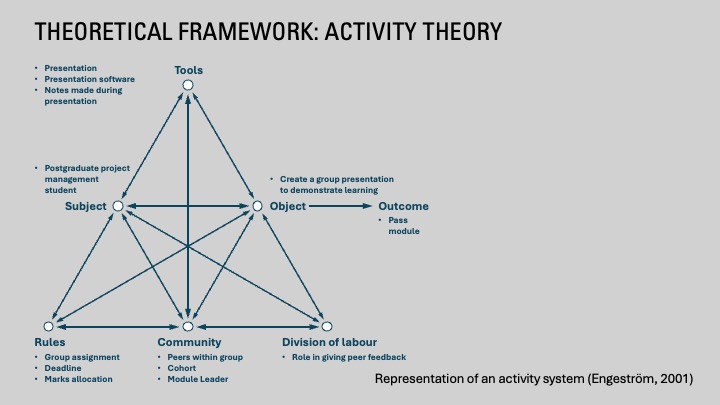
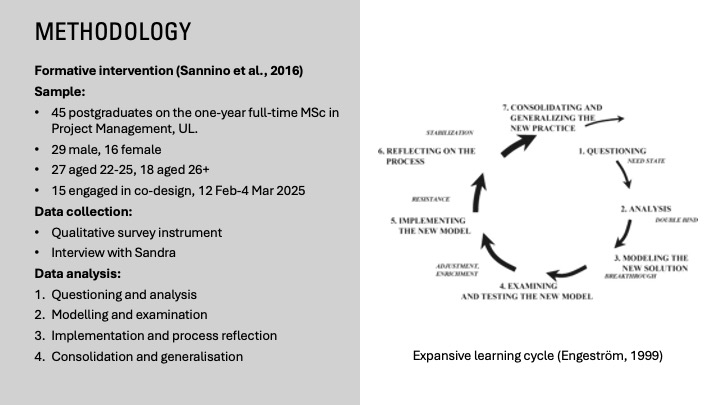
Engeström’s expansive learning cycle on the other hand, was something that very much resonated with me. The cycle has four different stages that when applied to our research looked like this:
1. Questioning and analysis, trying to understand the challenges the students experienced.
2. Modelling and examination, looking at what I and the students wanted to co-create.
3. Students’ experience of the process and the assessment along with their reflections on the process.
4. Consolidation and generalisation, which is about trying to learn from the positive impacts of the co-design process, also from anything that didn’t work out as planned and seeing how this might inform the future development of the approach.
We met most Friday afternoons over the summer and early autumn months to review progress and discuss next steps. Decisions regarding what potential outlets (journals, conferences etc.) might be interested in our work, and dividing up the tasks between us to progress these decisions were discussed and assigned to one of us. January and February were busy months with online and in-person presentations while we awaited decisions by a prominent journal in the field of assessment and the abstract reviewers for the AHE2026 conference. Ultimately, both were accepted with our paper published online on 11 April, and acceptance to present at AHE2026 on 18 June.
For me, the collaborative experience has been extremely rewarding, and I have learned loads, adding to my bank of lifelong learning experiences. The paper is available with open access for anyone to read:
Flynn, S., & Gatrell, D. (2026). Supporting postgraduate students’ engagement: an Activity Theory analysis of the impact of a co-designed assessment. Assessment & Evaluation in Higher Education, 1–25. https://doi.org/10.1080/02602938.2026.2656297
Until next time, Sandra
References:
Engeström, Y. (1999). Activity Theory and Individual and Social Transformation. Perspectives on Activity Theory 19 (38): 19–30. https://doi.org/10.1017/cbo9780511812774.003.
Engeström, Y. (2001). Expansive Learning at Work: Toward an Activity Theoretical Reconceptualization. Journal of Education and Work 14 (1): 133–156. https://doi.org/10.1080/13639080020028747.
Flynn, S., & Gatrell, D. (2026). Supporting postgraduate students’ engagement: an Activity Theory analysis of the impact of a co-designed assessment. Assessment & Evaluation in Higher Education, 1–25. https://doi.org/10.1080/02602938.2026.2656297
Sannino, A., Engeström, Y. & Lemos, M. (2016). Formative Interventions for Expansive Learning and Transformative Agency. Journal of the Learning Sciences 25 (4): 599–633. https://doi.org/10.1080/10508406.2016.1204547

